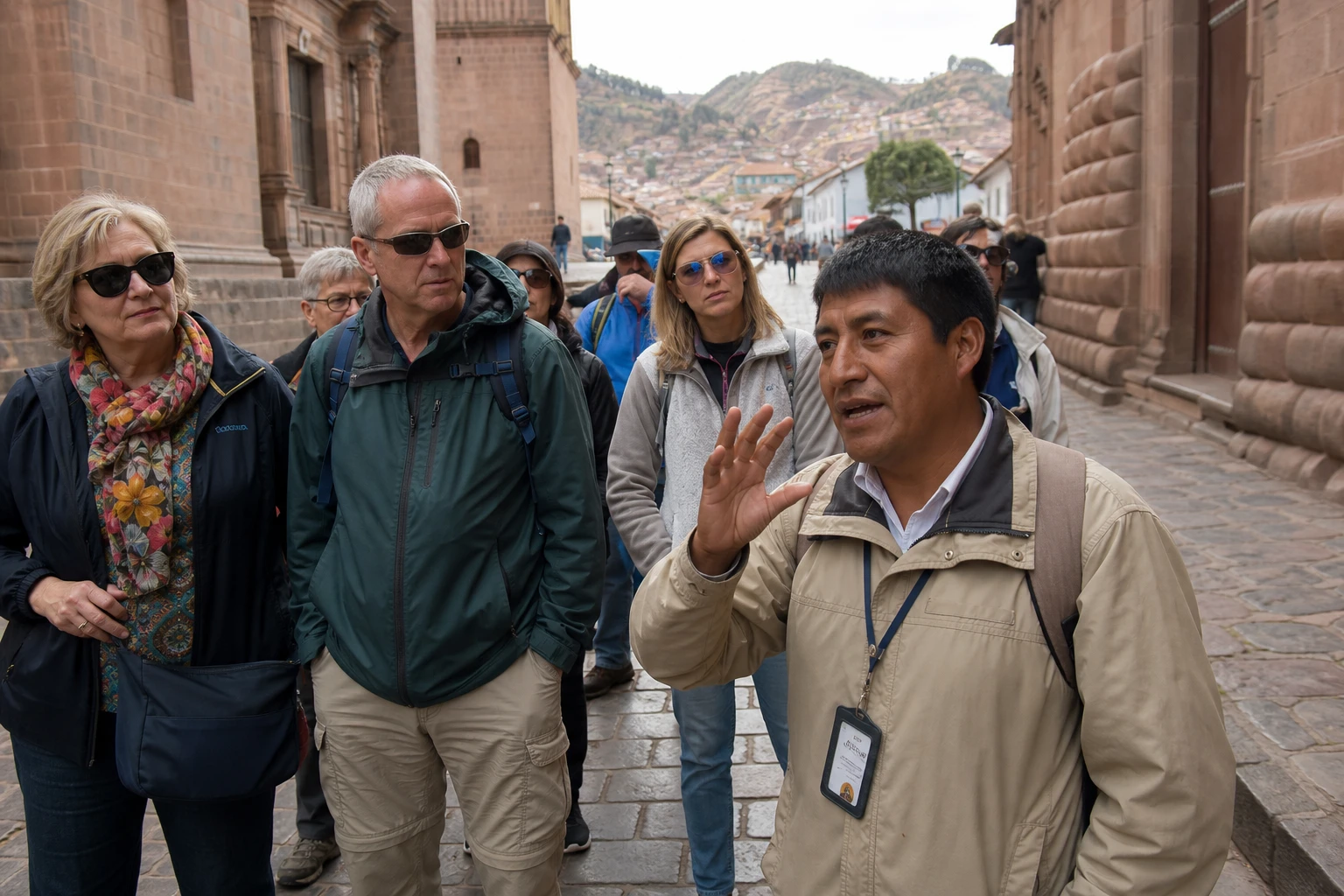
Cusco Walking Tours Guide
A walking tour is one of the simplest ways to understand central Cusco. Routes can connect Plaza de Armas with Inca and colonial landmarks, neighborhood streets, museums, viewpoints, and food stops. The important detail is that tours carrying the same general label can offer very different experiences, so compare the route before choosing.
Most organized city-center walks take about two to 2.5 hours. Tip-based tours and fixed-price small-group options are both available, while independent travelers can build a self-guided route through the Historic Center, San Cristóbal, and San Blas.

Cusco: Rainbow Mountain & Red Valley Premium Day Trip with Meals
Beat the crowds with early access to Rainbow Mountain (Mt. Vinicunca) and Red Valley on this full-day guided tour from Cusco. Admire the vibrant color...

Excursión to Humantay Lake Full Day from Cusco
The Humantay Laguna Tour of 1 Day was for nature lovers who have a day off or visitors who arrive in Cusco and can n...

Rainbow Mountain Beat-the-Crowd, Small Group - 8:00 AM Departure
Rainbow Mountain is Peru's second most visited destination after Machu Picchu. And with that popularity comes the cr...
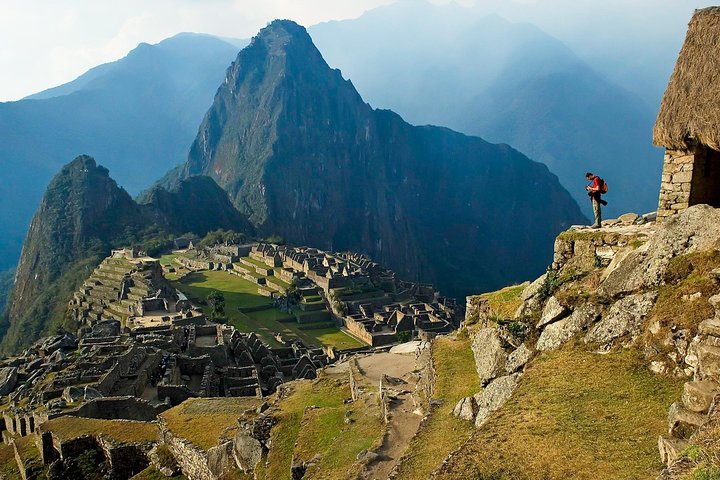
2-Day Sacred Valley & Machu Picchu Tour from Cusco by Train
Discover the magic of Peru completely stress-free on our beautifully organized 2-day tour. Unlike basic, low-end opt...
Cusco walking tour essentials
- Allow about two to 2.5 hours for a typical organized city-center walk.
- Confirm the exact meeting landmark because operators use several locations around Plaza de Armas.
- Choose by route, language, group size, and inclusions rather than by the words “free tour” alone.
- Wear comfortable footwear and carry water, sun protection, and a light jacket.
- Ask about gradients, stairs, surfaces, pace, and toilet stops if you have mobility or access requirements.
Why explore Cusco on foot?
Cusco’s Historic Center works well as the core of a walking itinerary. Peru’s official tourism information presents it as a starting point for exploring nearby attractions and recommends continuing through San Cristóbal and San Blas. Qorikancha, Cusco Cathedral, and several museums are among the central sights that can be incorporated into a day on foot.
A guided walk adds structure. Instead of deciding at every corner where to go next, you follow a defined route and hear an explanation of the places along it. A self-guided walk gives you more control over pace and time inside individual attractions. The better choice depends on whether you value interpretation or flexibility most.
Walking tours can also serve as an orientation activity near the start of a visit. Multiple departure periods are advertised across the market, so an early or afternoon walk can fit around other plans. Schedules differ by operator and can change, making the time shown on your booking confirmation the one that matters.
Choose the right type of walking tour
Start by deciding how much structure you want. Cusco has tip-based walks, fixed-price small-group tours, and enough central attractions for an independent route. These formats overlap geographically, but they differ in cost model, group predictability, language, pace, and the amount of personal attention available.

Tip-based walking tours
A “free” walking tour generally means there is no fixed charge collected in advance. The reviewed operators ask participants to make a voluntary contribution after the walk. This format lowers the upfront commitment, but it should not be interpreted as a promise that the experience has no cost.
Tip-based tours often cover the central area, but group size can be less predictable and itineraries can change. They suit travelers who want an introduction without committing to a fixed-price booking. Check the advertised language, route, duration, and whether registration is required before arriving.
Fixed-price small-group walks
A fixed-price tour offers a clearer cost and can provide a more controlled group size. One reviewed operator advertises an English-language walk with no more than 10 participants and a price of US$15 per person, paid in cash on the tour day. Treat that as one operator’s offer rather than a standard citywide rate, and check the current listing before booking.
This format is worth considering when hearing the guide easily, asking questions, or keeping the group compact matters more than minimizing the upfront cost. A stated maximum group size is more useful than broad wording such as “small group,” so look for a specific limit in the tour description.
Self-guided walks
Independent exploration is practical in the Historic Center, especially when you want to stop inside Qorikancha, Cusco Cathedral, or a museum on your own schedule. San Cristóbal and San Blas can extend the route beyond the immediate center. Build in fewer stops than you think you need, then add more only if your energy and time allow.
For a closer look at the neighborhood portion, a San Blas Cusco travel guide can help you decide how much time to devote to that area. Travelers interested in masonry can also plan a dedicated Twelve-Angled Stone walk rather than treating the landmark as a rushed photo stop.
| Tour format | Best for | Main tradeoff |
|---|---|---|
| Tip-based group walk | A low upfront commitment and a general introduction | Final contribution and group size are less predictable |
| Fixed-price small group | A defined cost and more controlled group size | Usually requires a firmer booking decision |
| Self-guided route | Flexible pacing and longer attraction visits | No guide to organize the route or provide live interpretation |

The Ultimate Full Day Sacred Valley Tour
Beat the Crowds: Experience the magic without the masses. We've meticulously planned our itinerary to ensure you arr...

Machu Picchu: Private Tour Guide Service (2–3 Hours)
Spend an unforgettable visit to Machu Picchu with your own private local guide. Meet in Aguas Calientes (hotel or tr...

Cusco City Tour Four Ruins in Half-Day
Enjoy the Ancient Inca Capital of Cusco .This Tour is half a day that includes a visit to the main square , the Temp...
Compare routes before booking
The phrase “Cusco walking tour” does not describe one standard itinerary. Some routes focus on the Historic Center and landmarks such as Plaza de Armas, Calle Loreto, Qorikancha, Kusicancha, and the Twelve-Angled Stone. Others add viewpoints, museums, tastings, or neighborhood exploration.
Read the stop list in order, not just the headline. A tour that includes more places is not automatically better if several stops are brief or if the route spends little time on your main interests. Look for a focused itinerary with a realistic duration and clear wording about any interior visits or tastings.
Historic Center landmark routes
Choose a landmark-focused route for a first introduction to central Cusco. Plaza de Armas, Calle Loreto, Qorikancha, Kusicancha, and the Twelve-Angled Stone appear across current tour descriptions. Exact combinations vary, so identify the two or three places you most want to see and make sure they are explicitly named.
Neighborhood and viewpoint routes
Neighborhood walks can move beyond a checklist of major monuments and place more emphasis on areas such as San Blas or San Cristóbal. Viewpoints are also advertised on some itineraries. Before choosing one, compare the physical demands with a central route and ask for the precise gradient, surfaces, and stairs if those details affect your participation.
Tours with museums or tastings
Some operators advertise museums, food tastings, or both. Check what “included” means before comparing value. A place appearing on the itinerary does not necessarily establish that admission or a tasting is covered by the tour. Review the selected package for included entries, food, and any separate payments.
Meeting points around Plaza de Armas
There is no single meeting point shared by all Cusco walking tours. Operators currently use several central landmarks, including the Plaza de Armas fountain, the Inca statue, Plaza Regocijo, and the area outside McDonald’s. These places are close enough to confuse a hurried traveler but distinct enough to miss a departure.
Save the operator name, meeting landmark, departure time, and any guide-identification instructions before leaving your accommodation. Do not rely on finding a group carrying umbrellas or gathering somewhere in the main square. If you are still arranging your arrival, the Cusco Airport to Historic Center transportation guide can help you plan the transfer separately from the walk.
Arrival instructions also vary. One operator asks guests to arrive five minutes early, while another recommends 10 to 20 minutes for organizing participants by route and language. Reaching the meeting point about 15 minutes before departure is a sensible planning buffer, unless your confirmation gives a different instruction.
How long to allow
Allow about two to 2.5 hours for a typical organized city-center tour. Add time before the departure to find the correct guide, plus a little flexibility afterward if you want to return to a landmark or enter an attraction independently.

Several daily departure periods are advertised across current operator offerings, which can make a morning or afternoon orientation possible. Do not build a tight connection around a timetable copied from an old listing. Recheck the operator’s current schedule and use the departure shown in your confirmation.
If the walk is one part of a longer visit, a 3 Days in Cusco itinerary can help place it alongside other city activities. A central tour works best when the rest of that half-day remains flexible rather than being packed with another fixed departure.
Still comparing Walking Tours?
Ask for tour ideas, hotel suggestions, or a simple trip plan that combines both.
Trip Helper
Costs, tips, and attraction tickets
Cusco walking tour costs depend on the format. Tip-based operators advertise no fixed upfront fee and invite a voluntary contribution. Fixed-price options set a charge in advance, although payment methods can differ. Compare the total experience rather than assuming one format always offers better value.
Keep tour payment separate from attraction admission in your budget. Some places encountered during a route can require their own ticket. The published adult price for the Integral Cusco Tourist Ticket is S/130, but travelers should check which sites it covers and whether any of those sites are part of the planned route.
Before paying, review the selected tour for language, duration, group-size policy, admission, tastings, and payment method. These details provide a fairer comparison than price alone, particularly when two tours use similar names but follow different routes.
Walking effort and accessibility
A tour through central Cusco should not automatically be treated as a low-exertion activity. One operator describes its 2.5-hour route as manageable while visitors adjust to altitude, and another says its two-hour tours suit most ages. Those descriptions support viewing a central walk as gentler than an out-of-town hike, not as universally accessible.
Travelers concerned about altitude can review practical altitude acclimatization in Cusco before deciding when to schedule a tour. On the day, choose a pace that matches how you feel and avoid using the advertised duration as a reason to push through a route that is not working for you.
Detailed step-free, wheelchair, hearing, and sensory-access information is not consistently published for individual routes. Before booking, ask for the exact path, gradients, stairs, walking surfaces, toilet stops, pace, and availability of vehicle backup. A general claim that a tour suits most ages does not answer those specific access questions.
What to wear and carry
Keep your walking kit simple: comfortable footwear, water, sun protection, and a light jacket. Current operators recommend these items because conditions can change during a tour. A compact load is easier to manage than a large daypack when the itinerary includes repeated stops.
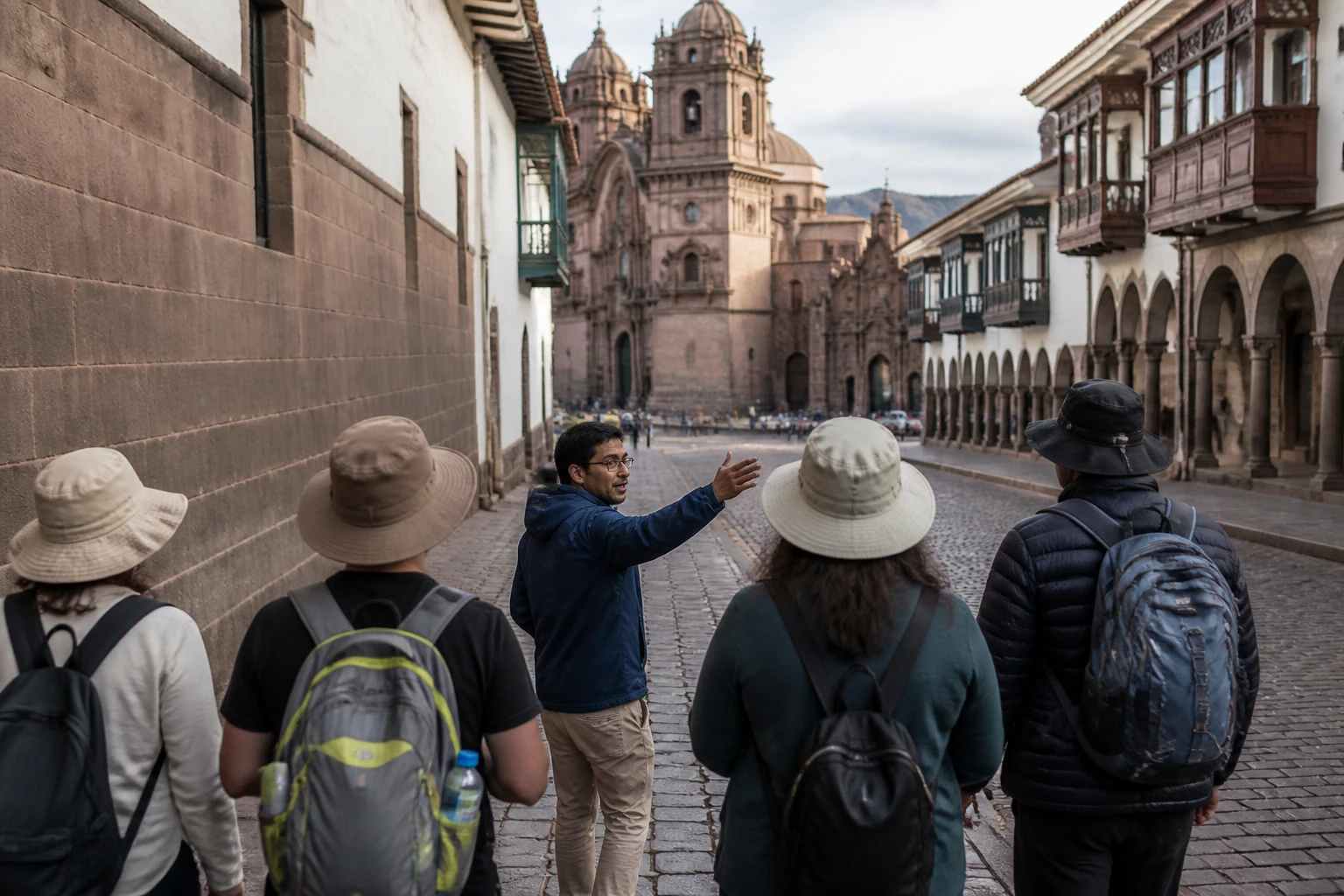
- Comfortable footwear suitable for about two hours of walking
- Drinking water
- Sun protection
- A light jacket
- Booking details with the exact meeting landmark and time
Bring the payment method stated by the operator. One fixed-price tour requests cash on the day, while tip-based walks rely on voluntary contributions. Requirements are operator-specific, so follow the instructions for the particular tour you selected.
A simple planning checklist
- Choose between a tip-based tour, fixed-price small group, and self-guided route.
- Compare the named stops and decide whether you want landmarks, neighborhoods, museums, viewpoints, or tastings.
- Check the tour language, duration, group-size policy, inclusions, and payment method.
- Save the precise meeting landmark and plan to arrive about 15 minutes early unless told otherwise.
- Pack water, sun protection, comfortable footwear, and a light jacket.
- Ask route-specific accessibility questions when gradients, stairs, surfaces, pace, or toilet access matter.
Is a Cusco walking tour worth it?
A Cusco walking tour is a strong choice for travelers who want a structured introduction to the Historic Center without devoting an entire day to one activity. The usual two to 2.5-hour format leaves room for independent exploration, and the range of routes allows you to emphasize major landmarks, neighborhoods, museums, viewpoints, or food.
The main limitation is inconsistency between tours. Meeting points, group sizes, routes, languages, inclusions, and payment models differ. Choose the itinerary first, then check the operational details. That small amount of preparation turns a vague “free tour” search into a walk suited to your interests and pace.
Frequently asked questions
How long do Cusco walking tours take?
Most organized city-center walking tours last about two to 2.5 hours. Add time to locate the guide before departure and review the current operator schedule because times can change.
Are free walking tours in Cusco actually free?
They generally have no fixed upfront charge, but guides invite a voluntary contribution at the end. The amount is not standardized across the market.
Where do Cusco walking tours meet?
Meeting points vary around central Cusco. Current operators use landmarks including the Plaza de Armas fountain, the Inca statue, Plaza Regocijo, and the area outside McDonald’s, so check your specific confirmation.
What places can a Cusco walking tour include?
Routes can include Plaza de Armas, Calle Loreto, Qorikancha, Kusicancha, the Twelve-Angled Stone, museums, viewpoints, tastings, and neighborhood areas. The exact combination depends on the operator and selected tour.
Are Cusco walking tours accessible for wheelchair users?
Accessibility depends on the precise route, and detailed step-free information is not consistently published. Ask about gradients, stairs, surfaces, toilet stops, pace, and vehicle backup before booking.
What should I bring on a Cusco walking tour?
Bring comfortable footwear, water, sun protection, and a light jacket. Also save the exact meeting landmark, departure time, and payment instructions for your operator.
Do I need the Cusco Tourist Ticket for a walking tour?
Not necessarily, because the need for admission depends on the route and whether you plan to enter covered attractions. The published adult price for the Integral Cusco Tourist Ticket is S/130, so confirm its coverage before purchasing.

Inca Trail 4-Day Trek to Machu Picchu – Return by Vistadome Train
Travel confidently with Alpaca Expeditions, Peru's #1 Tour Operator!. 3 Guarantees for Your Inca Trail Adventure: Safety, Quality, and Expert Guidan...

Sacred Valley Full Day Tour
The Sacred Valley of the Incas is one of Peru's most iconic destinations and one of the main gateways to discovering...

Peruvian Cooking Class Cocktails and Market Tour in Cusco
You will cook 3 Peruvian courses and 2 cocktails. Our Peruvian Cooking, cocktails and market tour starts at San Pedr...

Excursion to Rainbow Mountain Full Day Optional Red Valley
It is an impressive day of hiking in the Cordillera Vilcanota, "which is very close to the highest and sacred mounta...

5 Day Salkantay Trek to Machu Picchu Classic Guided Hike
The Salkantay Trek to Machu Picchu is an unforgettable journey through high Andean mountains, turquoise lakes, cloud forest and ancient Inca trails...

4-Day Salkantay Trek to Machu Picchu with Vistadome Train
Walk into the heart of the Andes on a 4-day Salkantay trek to Machu Picchu, perfect if you want adventure with comfo...

Horseback Riding Mystic Tour Temple of the Moon & Chacan Mountain
Pick up at your hotel at 9:00 am or 1:00 pm Meet our noble horses at the ranch. An informative briefing before you...

Machu Picchu Tour Full Day by Train
Experience the awe-inspiring Inca ruins of Machu Picchu, known as one of the New 7 Wonders of the modern world, on a...


