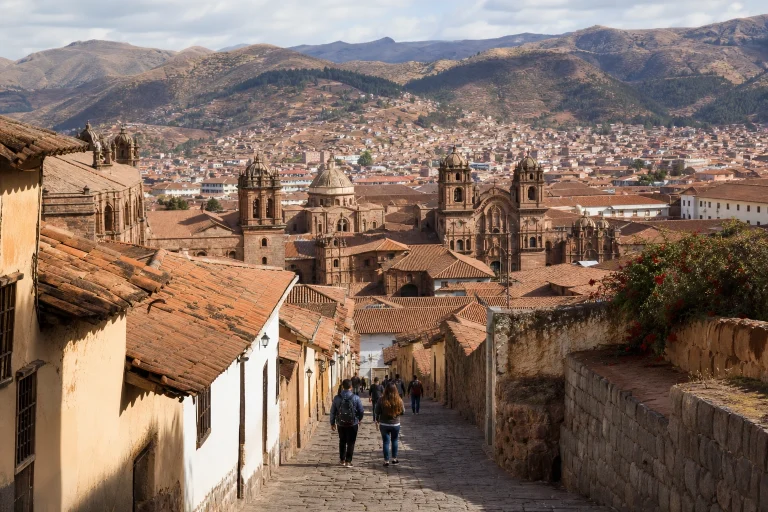
Cusco Souvenir Shopping Guide
Smart Cusco souvenir shopping starts with place, then with questions. Peru’s official tourism material highlights handicrafts, silverware, and alpaca goods as key shopping categories. San Blas suits craft-focused browsing, while Mercado de San Pedro adds a market stop where souvenir opportunities sit alongside its primary role as Cusco’s main food market.
Treat the two areas as complementary rather than interchangeable. San Blas is the stronger choice for an artisan-neighborhood atmosphere, while San Pedro works well for travelers who also want a food-market visit. For any purchase, treat composition, provenance, and return terms as details to confirm with the individual seller.

Peruvian Cooking Class Cocktails and Market Tour in Cusco
You will cook 3 Peruvian courses and 2 cocktails. Our Peruvian Cooking, cocktails and market tour starts at San Pedro Market (door number 1), with a v...

Cusco City Tour Four Ruins in Half-Day
Enjoy the Ancient Inca Capital of Cusco .This Tour is half a day that includes a visit to the main square , the Temp...

Bean to Bar Chocolate Workshop in ChocoMuseo Cusco
Learn how to make your own chocolate on a 2-hour workshop at the ChocoMuseo in Cusco. This is a hands-on activity, s...
Start with the right shopping district
- Choose San Blas for artisan-focused browsing, while allowing for its elevated streets and uphill walking.
- Add Mercado de San Pedro as a food-market stop with souvenir possibilities, not as a dedicated artisan mall.
- Compare stated fiber content, workmanship, weight, finishing, return terms, and receipts before committing to a purchase.
- Shop earlier in the day when possible, then confirm same-day hours with the seller or venue, especially on Sundays and holidays.
- Do not pack coca leaves or coca tea in luggage bound for the United States.
A simple two-stop plan keeps expectations clear. Browse San Blas when the priority is artisan-oriented shopping. Use San Pedro for a broader market experience, then look for souvenirs without expecting every stall or aisle to serve that purpose.

| Shopping stop | Best use | Practical consideration |
|---|---|---|
| San Blas | Artisan-neighborhood browsing | Its elevated setting makes uphill walking part of the plan. |
| Mercado de San Pedro | Food-market visit with souvenir opportunities | The surrounding Plazoleta San Pedro is pedestrian, while bordering streets have mixed use. |
San Blas for an artisan-neighborhood browse
San Blas has a long-established identity as a district of artisans, with continuity described from Inca times to the present. That makes it the natural first stop for travelers hoping to browse craft-oriented goods in a neighborhood setting. It is a good place to take time with individual items rather than treating every label as a guarantee of material or maker.
The neighborhood sits in an elevated part of Cusco, so the walk matters when you are carrying purchases or have limited mobility. Keep the uphill section in mind before buying a larger item. The San Blas Neighborhood Guide is a useful companion for understanding the district’s streets while planning a browse at a comfortable pace.
Use San Blas to compare goods and seller information. A product promoted as alpaca, silver, handmade, or locally made still requires seller-specific answers about its composition and provenance. That small pause before paying is more useful than assuming a neighborhood identity verifies every object on display.
Mercado de San Pedro for a market stop
Mercado de San Pedro is best approached as Cusco’s main food market, with souvenir opportunities as part of a wider visit. This distinction helps you use the stop well. Go for the energy and practical appeal of a market setting, then browse selectively rather than expecting a purpose-built handicraft center.
The Plazoleta San Pedro area is pedestrian, while the streets around it have mixed use. If you plan to arrive or leave by taxi, arrange pickup on a surrounding street instead of assuming curbside access at every entrance. The San Pedro Market Guide can help shape a market visit around that setting.
If time is short, decide in advance if your priority is food-market browsing or a focused souvenir search. San Pedro can serve both interests in one stop, but it remains primarily a food market. Save a more craft-centered comparison for San Blas or another individual seller elsewhere in Cusco.
Know the main souvenir categories before you browse
Handicrafts, silverware, and alpaca goods are the principal souvenir categories highlighted for Cusco. A short list helps prevent a rushed decision: choose the category that matters most to you, compare similar items across more than one seller, and ask direct questions when material or origin matters to your purchase.

5 Day Salkantay Trek to Machu Picchu Classic Guided Hike
The Salkantay Trek to Machu Picchu is an unforgettable journey through high Andean mountains, turquoise lakes, cloud...

Combo Sacred Valley Pisac Moray Salt Mines and Ollantaytambo
The full day experience through the Sacred Valley of the Incas is a full day tour that visits all of the four main h...

Palcoyo Rainbow Mountain Full Day Tour from Cusco
Escape the crowds and discover a quieter, equally stunning alternative to Vinicunca on this full day Palccoyo Rainbo...
Alpaca goods: focus on stated composition
For alpaca goods, begin with the exact fiber content stated by the seller. Compare items described with the same composition, then look at workmanship, weight, and finishing. This gives you a clearer basis for judging two similar pieces than relying on broad marketing language alone.
Do not treat a general alpaca label as proof of a particular fiber percentage or local artisan provenance. Ask the seller to explain the item’s composition before buying. If that detail is important to you, make it part of the comparison rather than an afterthought at the checkout.
Silverware and handicrafts: compare the details that matter
Apply the same careful approach to silverware and handicrafts. Compare workmanship, weight, and finishing among comparable pieces. If the material or origin is central to your decision, ask the seller directly and keep the answer in mind when comparing another item nearby.
An itemized receipt is a practical final step. Request one from the seller and review the stated item details before leaving. It helps you keep a record of the purchase and supports a more deliberate decision when several similar goods have caught your eye.
Judge value with a consistent shopping method
A universal price script cannot tell you how a particular object was made or what it contains. A better approach is to compare like with like and decide which details matter most for the souvenir you want to carry home. This is especially useful when goods have similar descriptions but different finishing or stated materials.
- Compare stated fiber content when looking at alpaca goods, rather than comparing only the product name.
- Examine workmanship, weight, and finishing across pieces that serve the same purpose.
- Ask about return terms before payment, since terms are specific to the seller.
- Ask the seller to clarify material and provenance when either affects your decision.
- Request an itemized receipt and keep it with your travel documents.
This method does not turn a seller’s statement into a blanket guarantee. It does give you a clear record of what you were told and a fair basis for comparison. Shoppers who care most about fiber content, materials, or origin should make those questions their first filter, not their last.
Plan around timing, walking, and accessibility
Build in time to shop earlier in the day when possible, then confirm same-day hours with the seller or venue before making a special trip. This is particularly useful on Sundays and around holidays, when schedules can differ. Keep the rest of the day flexible enough to return to a shop if a purchase needs more thought.

Arriving at and leaving San Pedro
The pedestrian Plazoleta San Pedro and the mixed-use streets around it call for a simple transport plan. Walk into the pedestrian setting, then use the surrounding streets for a taxi arrangement when needed. This approach is more practical than expecting vehicle access directly beside every market entrance.
Preparing for San Blas and mobility needs
San Blas rewards a lighter-bag strategy because its elevated position brings uphill walking into the outing. Travelers who need step-free access, seating, accessible toilets, or other mobility arrangements should contact the specific shop or market before setting out. Do not assume that one venue’s access arrangements apply across the neighborhood.
Still comparing Cusco Souvenir Shopping And Market Planning?
Ask for tour ideas, hotel suggestions, or a simple trip plan that combines both.
Trip Helper
Keep home-country import rules in mind
Travelers returning to the United States should leave coca leaves and coca tea out of their souvenir plans. U.S. Customs and Border Protection states that bringing coca leaves into the country is illegal, including products intended for tea or chewing. This is one purchase decision best made before reaching the airport.
Other ordinary-looking purchases can also be restricted or prohibited at the border, including certain animal products and by-products. Check U.S. import rules before buying animal-derived, plant-based, or food souvenirs, and declare purchases as required. The caution is item-specific and does not mean every alpaca textile is barred from entry.
For travel to countries other than the United States, check the entry rules for your own destination before committing to a plant-based, food, or animal-derived souvenir. Put that check before the purchase, especially when an item cannot easily be returned.
Build shopping into your Cusco days without rushing
The easiest shopping rhythm has two stages: browse first, buy second. Use the first stage to compare categories, materials, and finishing. Use the second to return to the seller that best meets your priorities. This approach also keeps your bag lighter before an uphill browse through San Blas.
Use a browse-then-buy plan
- Confirm the day’s opening arrangements before making a dedicated shopping trip.
- Visit San Pedro when a food-market stop fits your plans, while remembering that souvenirs are secondary to its market role.
- Browse San Blas when artisan-oriented shopping is the priority, allowing for its elevated streets.
- Compare similar goods, then ask seller-specific questions about composition, provenance, return terms, and receipts.
- Before the final purchase, check that the item suits your home-country import rules.
This plan suits a short visit as well as a longer Cusco stay because it separates browsing from decision-making. It also avoids treating one market or neighborhood as the answer to every souvenir need. San Pedro and San Blas work best as different chapters of the same shopping day.
Make room for a closer look
Cusco is a strong place to shop for handicrafts, silverware, and alpaca goods when you give yourself time to compare. Choose San Blas for its artisan-neighborhood character and San Pedro for its food-market setting with souvenir opportunities. The main limitation is that details such as composition, provenance, hours, access, and return terms are seller-specific. Ask clearly, keep your receipt, and save U.S.-bound luggage space for anything except coca products.

Frequently asked questions
Where are the best places for souvenir shopping in Cusco?
San Blas is the best choice for an artisan-focused neighborhood browse, while Mercado de San Pedro is best treated as a food-market visit with souvenir opportunities. Use both stops if you want to compare the setting and goods before buying.
Is Mercado de San Pedro a dedicated artisan market?
No. Mercado de San Pedro is primarily Cusco’s main food market, though it can be included in a souvenir-shopping plan. Visit it for the market experience and browse selectively for gifts rather than expecting a dedicated handicraft mall.
What souvenirs should I look for in Cusco?
Handicrafts, silverware, and alpaca goods are the leading souvenir categories highlighted for Cusco. Compare similar items by stated composition, workmanship, weight, and finishing before deciding.
How can I assess alpaca goods and other handmade souvenirs?
Ask for the stated fiber content or material, then compare workmanship, weight, finishing, return terms, and an itemized receipt. Composition and provenance are seller-specific, so do not rely on broad product labels alone.
What is the best time to go souvenir shopping in Cusco?
Shop earlier in the day when possible and confirm same-day hours directly with the seller or venue. This matters most on Sundays and around holidays, when schedules can differ.
Can I bring coca tea home from Cusco to the United States?
No. U.S. Customs and Border Protection states that bringing coca leaves into the United States is illegal, including coca products intended for tea or chewing.
Are San Blas and San Pedro accessible for travelers with limited mobility?
Accessibility arrangements need to be confirmed with the specific shop or market before you go. San Blas is in an elevated part of the city, and the available information does not establish consistent step-free features, accessible toilets, seating, or aisle access across these shopping areas.
Bean to Bar Chocolate Workshop in ChocoMuseo Cusco
Learn how to make your own chocolate on a 2-hour workshop at the ChocoMuseo in Cusco. This is a hands-on activity, starting from the cocoa tree to the...
Peruvian Cooking Class Cocktails and Market Tour in Cusco
You will cook 3 Peruvian courses and 2 cocktails. Our Peruvian Cooking, cocktails and market tour starts at San Pedr...

Machu Picchu: Private Tour Guide Service (2–3 Hours)
Spend an unforgettable visit to Machu Picchu with your own private local guide. Meet in Aguas Calientes (hotel or tr...

Excursion to Rainbow Mountain Full Day Optional Red Valley
It is an impressive day of hiking in the Cordillera Vilcanota, "which is very close to the highest and sacred mounta...
Peruvian Cooking Class Cocktails and Market Tour in Cusco
You will cook 3 Peruvian courses and 2 cocktails. Our Peruvian Cooking, cocktails and market tour starts at San Pedro Market (door number 1), with a v...
Bean to Bar Chocolate Workshop in ChocoMuseo Cusco
Learn how to make your own chocolate on a 2-hour workshop at the ChocoMuseo in Cusco. This is a hands-on activity, s...
Cusco City Tour Four Ruins in Half-Day
Enjoy the Ancient Inca Capital of Cusco .This Tour is half a day that includes a visit to the main square , the Temp...

Inca Trail 4-Day Trek to Machu Picchu – Return by Vistadome Train
Travel confidently with Alpaca Expeditions, Peru's #1 Tour Operator!. 3 Guarantees for Your Inca Trail Adventure...